
01903 944594

BUILT WITH LESS
The environmental impact of a pool starts with how you build it
A swimming pool is a substantial structure. It requires materials, energy and resources to build and operate. We don't pretend otherwise.
At Orbro, we look at where materials can genuinely be reduced, where products can be properly documented, and how a pool can be designed as a permanent structure rather than something intended to be replaced.
MATERIAL EFFICIENCY
Approximately 25% Less Installed Material
We've compared the material required to construct the same representative swimming pool using different construction methods.
The defined pool is:
10.0 m × 5.0 m × 1.5 m
45 m² pool wall · 50 m² pool floor
11.21 TONNES LESS
That's approximately 25% less installed material by mass than the defined dense-block construction.
THE DIFFERENCE IS IN THE CONSTRUCTION
Less materials, fewer layers.
Using the ClipBlox system Orbro changes the way the way the pool shell is constructed
01
PERMANENT FORMWORK

ClipBlox forms the shuttering for the reinforced concrete wall and remains permanently in place. A standard ClipBlox unit weighs approximately 3.5 kg.
02
MONOLITHIC CONCRETE

Once filled, ClipBlox creates a 150 mm reinforced concrete wall without first constructing a conventional masonry wall around it.
03
FEWER ADDITIONAL LAYERS

The ClipBlox shell is ready to receive the final pool finish without the additional wall render and floor levelling/render layers included in our traditional block-built comparison.
We're building the same pool with a much lighter system.
Less material. Fewer construction layers. The same reinforced concrete structure.
Fewer materials and fewer construction stages can mean less labour, less time on site and a more cost-efficient build.
DON'T JUST TAKE OUR WORD FOR IT
See Exactly How We Calculated It
Anyone can put an environmental claim on a website. We'd rather show you the numbers behind ours.
Our comparison documents the dimensions, quantities, material densities, construction assumptions and published sources used to calculate each construction method.
It also shows exactly what we've included, what we've excluded and where we've used a clearly identified proxy rather than pretending every figure is exact.
DEFINED COMPARISON
10 × 5 × 1.5 m pool
45 m² pool wall
50 m² pool floor
150 mm common structural floor
What's included in the calculation?
Pool wall construction, concrete fill where required, masonry mortar and pool render/levelling layers where applicable, plus the same 150 mm structural concrete floor for each method.
MEASURED. DOCUMENTED. VERIFIED.
ClipBlox Has Its
Own Environmental Product Declaration.
An Environmental Product Declaration (EPD) provides standardised environmental information about a product based on life-cycle assessment.
The ClipBlox/SolidPool system has a third-party verified EPD, prepared within the recognised EN 15804+A2 framework.
So rather than simply describing ClipBlox as an environmentally responsible product, there is documented environmental data available to examine.


OUR CALCULATION. INDEPENDENT DOCUMENTATION. THE EVIDENCE IS THERE TO BE CHECKED.
LET'S TALK ABOUT THE OBVIOUS BIT
Concrete Has an Environmental Impact.
Our pools use reinforced concrete. Producing concrete consumes raw materials and energy and creates carbon emissions. Pretending otherwise wouldn't make our pools any more sustainable.
The question for us is how do we use it intelligently?
That means creating the structural performance and longevity we want while avoiding unnecessary material and additional construction layers wherever possible.
11.21 TONNES LESS MATERIAL
For our defined pool comparison, the ClipBlox build-up uses approximately 11.21 tonnes less installed material than the dense concrete-block alternative.
Less material means less to manufacture, transport, handle and install — with fewer construction layers and less time spent building the shell.
Less material isn't only an environmental benefit.
It's a construction benefit too.
THERE'S MORE THAN ONE WAY TO BUILD A POOL
Material Weight Isn't the Whole Environmental Story
Our material comparison deliberately concentrates on construction methods for which we could create a transparent like-for-like calculation. We haven't included every type of swimming pool. That doesn't mean their wider environmental considerations should be ignored.
SPRAYED CONCRETE / GUNITE

More Material. More Waste. More Specialist Labour.
Sprayed-concrete pools typically require substantial reinforcement, temporary formwork and specialist installation. The spraying process can also create rebound, where concrete fails to remain on the structure and becomes waste.
More materials, more waste and more specialist labour all add to the environmental and overall project cost.
ONE-PIECE FIBREGLASS / GRP
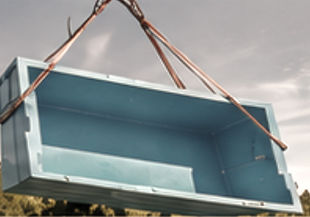
The Giant Bathtub Approach.
Made in a factory. Delivered on a lorry. Lowered into a hole.
One-piece pools can be quick to install, but ultimately you're choosing a pre-moulded composite shell from a predetermined range of shapes and sizes. Even fibreglass manufacturers acknowledge that transport limits the dimensions available.
Quick to put in. Much harder to answer what happens when it comes out.
REINFORCED CONCRETE + CLIPBLOX

The Smarter Way to Build a Concrete Pool.
The strength and permanence of a reinforced concrete pool shell, without the material-heavy construction of traditional methods.
ClipBlox uses lightweight permanent formwork, fewer construction layers and approximately 25% less installed material in our defined comparison.
Designed around your property. Built on site. Made to last.
LONGEVITY MATTERS
Built to stay built.
A pool shouldn't be a disposable product. Our reinforced concrete shells are designed as permanent structures that can remain while finishes, equipment and technology are upgraded around them.
Building swimming pools since 1999.
THINKING BEYOND DAY ONE
Consider the whole life of the pool.
Environmental impact doesn't stop when construction does. We consider what goes into a pool, how long it remains useful and what eventually happens to its materials.
Material use · Construction waste · Longevity · Repairability · End of life
HOW YOU USE YOUR POOL MATTERS
Efficiency continues after construction.
Covers, modern heat pumps, efficient pumps and filtration, sensible temperatures and intelligent controls can all reduce the energy required to operate a pool.
Designed to be enjoyed. Not constantly looked after.
TRANSPARENCY MATTERS
Evidence, Not
Environmental Marketing.
We'd rather make environmental claims we can demonstrate than broad claims we can't.
That's why our material comparison is based on a defined pool, published product data and clearly stated construction assumptions — with the full calculation available for anyone who wants to examine it.

REAL NUMBERS. PUBLISHED SOURCES. OPEN CALCULATIONS.


We can't build a swimming pool without using resources.
For us, responsible pool construction means using materials efficiently, designing for longevity, choosing documented products and being transparent about the evidence behind the claims we make.